

Abortion Before Roe
While advocating for Wisconsinites, Pat reflects on her pre-Roe abortion experience

On what should have been the 53rd anniversary of the landmark Supreme Court ruling in Roe v. Wade, Free & Just held an event in Madison, Wisconsin with storytellers and Senator Kelda Roys to discuss the latest attacks on abortion rights for Wisconsinites. After the event, we chatted with Patricia McFarland, a lifelong advocate who received abortion care in 1970, three years before the Supreme Court issued its ruling in Roe v. Wade.
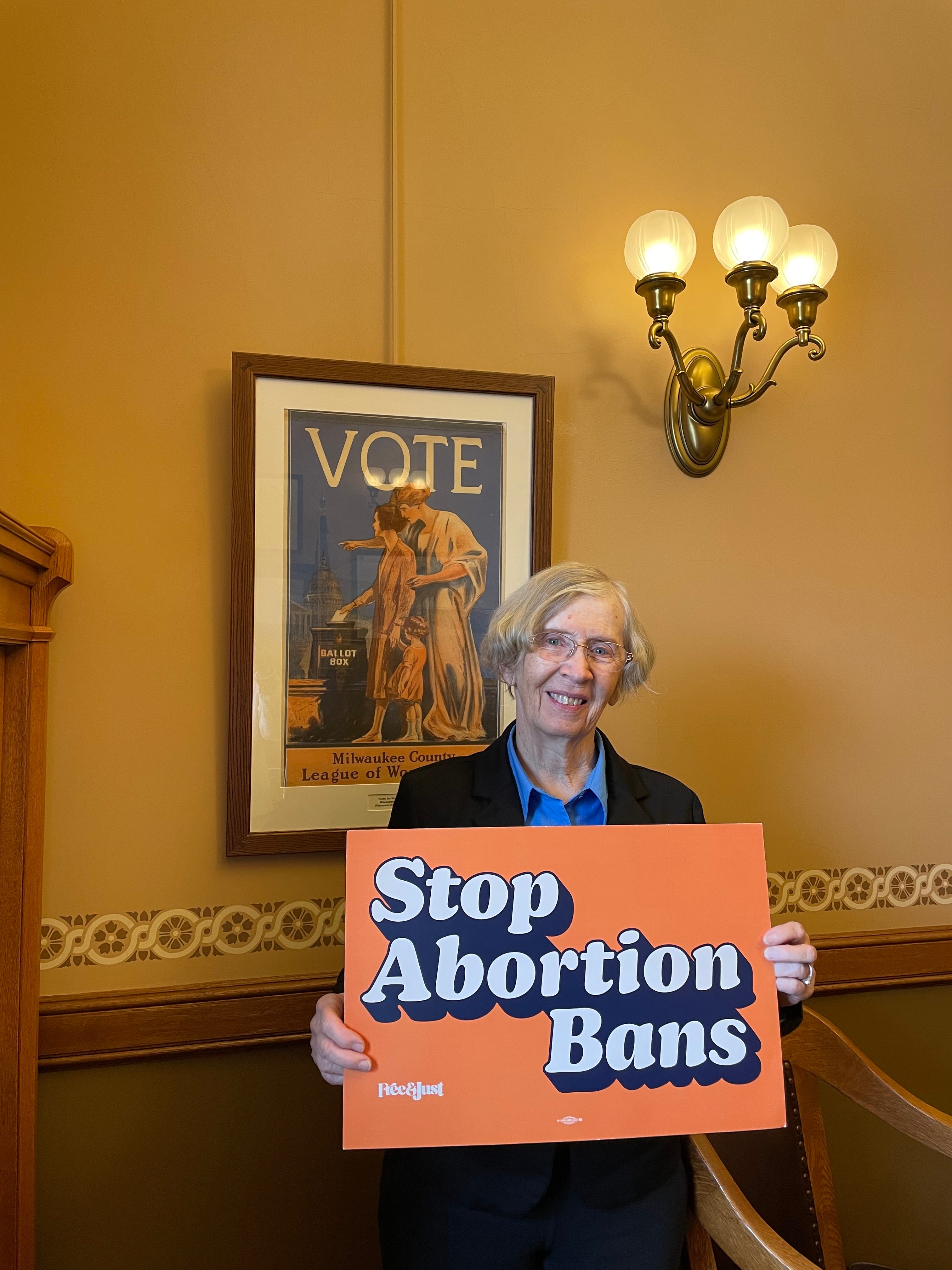
Pat’s Experience
“When I found out that my birth control failed, I knew that we would not go forward and have a baby together. But if that was going to be terminated, then I wanted it to be as soon as possible. I was a student here at the University of Wisconsin–Madison and the women’s center was doing counseling for people and again didn’t ever expect that it would be me. I just wanted to help other people. They said the fastest that you could get this done would be if you go to Mexico City. So Scott sold his car, got $600 for it, and that paid for flight to Mexico City and back.
I had one phone number to call when I got there. I was picked up and taken to a clinic that did not inspire confidence. I think the person who tried doing it was still pretty new at D&C.
When it was done, I kept bleeding and fainting. The staff came in with a series of 12 shots to stop the bleeding and told me I was ready to go back on the airplane. But if I wanted to have children, I better make sure I got help at the student clinic at the university. And that is what I did.
It was terrifying.”
After her own terrifying experience before abortion was legalized in the United States, Pat didn’t want to see others go through what she had to in order to receive abortion care. Three years later, she saw Roe v. Wade become the law of the land.
“I was as happy as I could possibly be. I truly worried about women who did not survive their attempt at ending pregnancy. I have met people who had back alley abortions. I had a friend who jumped from a hospital to end her life when the fourth baby was forced to be born, leaving her husband and three children behind. She could not face being a mother of four children. Truly I was happy that this would not happen; and I was grateful that if I ever had children, they wouldn’t have to deal with this.”
A Post-Roe Reality
For nearly 50 years, Pat and so many others saw Roe as established. Attacks on abortion rights persisted across various states, but this landmark ruling provided some level of protection at the federal level. When the Supreme Court overturned this ruling, Pat describes…
“It was shocking. I’m a member of a group, we call ourselves the persisters. We have more than 1,200 people on our mailing list and we take action every week, meeting weekly. During that time, we’re on Zoom and one of the brave persisters shocked me and said, ‘I’m just going to say I’m worried that we’re going to lose reproductive rights. And I have had an abortion. Has anyone here had an abortion?’
And I thought, oh my goodness, no one ever asked me that question. And I’ve kept it quiet for 50 years.
And I said, ‘yes, I had an abortion’ and they said, ‘Pat, what is your story?’ And when I told them, they said, ‘Pat, will you tell this at rallies? Will you tell this to candidates who are running for office? Will you tell it to Planned Parenthood? Will you speak up because you care about all these women who did not survive their attempt at ending a pregnancy?’
And I said, “Yeah, it’s my turn to speak up.”
Thus begins Pat’s experience sharing her abortion story. 50 years after it happened, she is inspiring her family and community and finding unexpected allies in this fight.
One of the strangest things for me was, because I was speaking at rallies and press conferences, I got a call from the Milwaukee Journal Sentinel. The reporter asked if I would agree to an interview–regardless of who wins this race for Wisconsin Supreme Court. My candidate was pretty open about the fact that she supported women’s rights.
Before I agreed to have her come to our home, I said, “Let me check with my husband. He’s very protective.”
The reporter asked where Pat would feel most comfortable having her photo taken for her article in the paper, and she immediately responded,
“Oh, my church.”
And she said, “Your church?”
And I said, “Yeah.” I said, “Let me call. I’m a Unitarian Universalist.” I said, “Hello, Reverend. I’m telling my story about Mexico City and the Milwaukee Journal Sentinel wants to come to church tomorrow to take pictures.
They said, “Oh, sure. What time are they coming?”
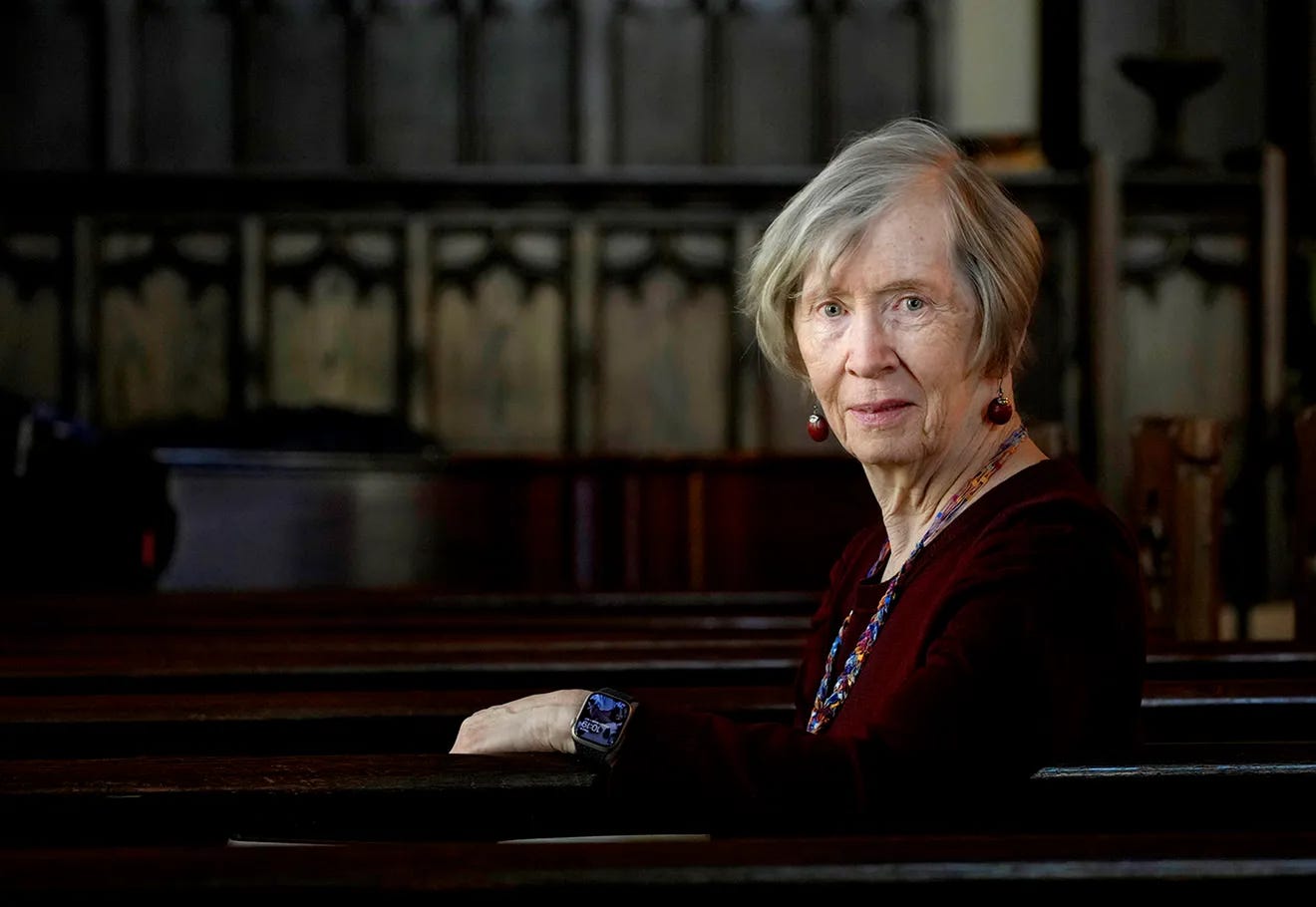
So, that’s where I had the picture taken. I waited to know when this was going to be published and it turned out to be on the front page of the Milwaukee Journal Sentinel on a Sunday.
My sister called me and said, “Pat, you’re on the front page.” And I said, “My 10-year-old granddaughter is here.” She said, “Time for her to read the article, Pat.”
And I said, “But I was going to wait till my granddaughters were older.” She said, “Time to read the article, Pat.” So, this little girl sits in the back seat reading the article.
And she says, “Grandma, why couldn’t you tell your mom?” And I said, “Oh, Anya, my mom would have been ashamed of me.”
She says, “Grandma, I’m sure your mom was proud of you every day of your life.” And when she went to school the next day, her friends said, “We saw brave Grandma Mac on the paper. Oh, this is wonderful, Anya.”
Another woman who I knew voted for Trump approached me at the gym. I thought, “Here it comes.” She said, “You and I disagree on everything.” I said, “I know. I know.” She said, “Except for this. I’m so proud of you.” And I have had no impact, no negative reaction for telling my story.
Advocacy in a Post-Roe Society
We asked Pat why it is still important to recognize the anniversary of Roe v. Wade. Her response was straight to the point.
“Women and people of conscience need to stand together. If we don’t stand together, we’re going to lose all of the dignity that we deserve.”
And, despite the overwhelming attacks on abortion, Pat remains hopeful.
“I’m hopeful because people are stepping up, resisting and saying, “No.” Surveys prove that many more of us are saying “no, we cannot have women dying about this. We cannot lose our rights.”
And so, that gives me hope.
In 1966, I spent 3 months and marched with Martin Luther King; I was 17 in Chicago in Cicero. I believe we can lead with love. I believe in equity. I believe in justice. I believe that people can learn and change. And I believe that stories do help us connect as human beings.”
To close, Pat shared more about where she draws inspiration from in her advocacy.
“So again, I’ll go back to Martin Luther King who believed the importance of taking a stand for justice; when our friends are silent, we care deeply that they have let us down.
But when our friends have the courage and they can nurture other people to do the right thing, to do what is just, that inspires me and will always inspire me.”
Thank you for courageously and powerfully telling your story, Pat